Ask five people how much it costs to build a house in Nigeria and you’ll get five different answers.
Your uncle says ₦60 million is enough. A contractor quotes you ₦70 million. A friend who just finished his bungalow tells you he spent ₦78 million and is still not done. One blog says one thing, a WhatsApp broadcast says another.
So you’re left confused. You can’t plan, you can’t save towards a clear target, and you keep postponing the dream of owning your own house.
We understand that frustration, because we see it every week. People come to us with land, with savings, with a dream, but no idea what the real number is. In this guide, we’ll show you exactly how building costs work in Nigeria today, what drives them up, and how you can arrive at a figure you can actually trust.
Why nobody can give you one straight answer
Here’s the truth most people won’t tell you: no one can price your house accurately until your house is drawn.
People come to us and ask the popular question “How much can build a 5 bedroom bungalow”, but the thing is, a “5-bedroom bungalow” is not one thing. It could be 100 square metres or 200 square metres. It could have a simple flat roof or a complex hip roof with many angles. It could have POP ceilings, granite tops and imported tiles, or simple finishes.
Every one of those choices changes the cost by millions. That’s why when you ask “how much to build a house?”, you get answers that are worlds apart. Everyone is pricing a different house in their head.
What building costs look like in Nigeria right now
Let me give you real market numbers so you have a starting point. These are rough ranges as of late 2026, before land and before professional fees.

| House type (foundation to finishing) | Rough cost range (Lagos/Abuja) |
|---|---|
| Standard 4-bedroom bungalow (120–150 sqm) | ₦60M – ₦85M |
| Standard 5-bedroom bungalow (150–200 sqm) | ₦70M – ₦95M |
| Standard 4-bedroom duplex (200–250 sqm) | ₦130M – ₦180M |
| Standard 5-bedroom duplex (250–350 sqm) | ₦150M – ₦200M |
| Standard 4-bedroom duplex (200–250 sqm) 2 storey | ₦150M – ₦200M |
| Standard 5-bedroom duplex (250–350 sqm) 2 storey | ₦170M – ₦220M |
| Standard 7-bedroom mansion (600-2000 sqm) | ₦600M – ₦2B |
If you’re building outside Lagos and Abuja, you may pay 15–30% less, mostly because of cheaper labour and land preparation.
Now let me show you why these numbers keep climbing. A 50kg bag of cement that sold for about ₦3,500 in 2021 now goes for between ₦12,000 and ₦15,000 in many markets. Iron rods are selling for about ₦800,000 to ₦1,100,000 per tonne. Long-span roofing sheets cost roughly ₦5,800 to ₦8,100 per square metre.
Materials alone take up a huge share of your total budget, so when prices move, your house moves with them.
first-time builders: avoid the mistakes that double your cost →
The 6 things that really decide what you’ll spend
When we’re working out a client’s budget at Bullionrise Consult, these are the six things I look at first.
- The size of the house. Cost follows square metres. Every extra room, corridor and veranda adds blocks, concrete and roofing.
- The shape of the house. A simple rectangle is cheaper to build than a house with many corners, projections and roof angles. The more complicated the shape, the more you pay.
- The soil on your land. Firm, dry soil means a normal strip foundation. Swampy or loose soil may need a raft or pile foundation, which can add millions before you even reach window level.
- Your finishing standard. Finishing (tiles, POP, doors, windows, sanitary wares, painting, electrical fittings) can be as expensive as the whole carcass. This is where most budgets break.
- Location and logistics. Distance from material markets, access roads, and local labour rates all affect your final figure.
- Time. The longer your project drags, the more inflation eats into your money. A house built in 8 months will usually cost less than the same house built over 4 years.
The stages of building and how your money is spent
It helps to think of your house in stages. Here’s how I explain it to my clients:
- Pre-construction: Building plan, structural drawings, soil test, approval and site clearing.
- Foundation (substructure): Setting out, excavation, foundation concrete, blockwork to DPC level, filling and German floor.
- Superstructure: Blockwork from DPC to lintel, lintel casting, and blockwork to roof level. For a storey building, this includes columns, beams and the decking.
- Roofing: Roof trusses, roofing sheets, fascia and gutters.
- Services: Electrical wiring (conduits), plumbing pipes, septic tank and soakaway.
- Finishing: Plastering, screeding, ceiling, tiling, doors, windows, painting and fittings.
Many people budget well for stages 2 to 4 and then get stuck at finishing for years. If you plan your budget stage by stage from day one, you’ll know exactly how much you need before you start, and you’ll avoid the abandoned “roofed but not finished” house.
Affordable duplex design collections →
How to get a building cost you can trust

Here’s the process I recommend to anyone who’s serious about building:
Step 1: Get a proper building plan first. Not a sketch, not a downloaded picture. A full plan with floor plans, elevations and sections. This tells you exactly what you’re building.
Step 2: Get a Bill of Quantities (BOQ). A BOQ takes your plan and turns it into exact quantities: how many blocks, how many bags of cement, how many tonnes of rods, how many square metres of tiles. When you have quantities, prices stop being guesses.
Step 3: Price the BOQ at current market rates. Prices change monthly in Nigeria, so price your BOQ close to the time you buy.
Step 4: Add a contingency of 10–15%. Naira movements, unexpected soil conditions and small design changes will happen. A contingency keeps your project moving when they do.
Step 5: Plan your cash flow. Match each stage of building with when your money will be available. This is how you avoid stopping halfway.
You’ll notice that everything starts with Step 1. Without a building plan, there’s no BOQ. Without a BOQ, every price you hear is a guess.
Get a building plan with free BOQ here →
Smart ways to reduce your building cost without building a weak house
You don’t have to sacrifice quality to save money. Here are some things I advise:
- Choose a compact, simple design. A well-planned house on a clean rectangle can save you millions compared to a house with many projections.
- Plan rooms carefully. Wasted corridors and oversized spaces cost money to build and maintain.
- Buy materials in bulk and at the right time. Rods are cheaper by the tonne than by the piece. Buy before prices jump if you can store them safely.
- Use a plan that allows phased building. Design your house so you can complete and move into part of it, then expand later.
- Don’t skip supervision. Material theft and poor workmanship are hidden costs that quietly double your budget.
Choosing a house design? These 15 questions matter more than looks →
Your next step
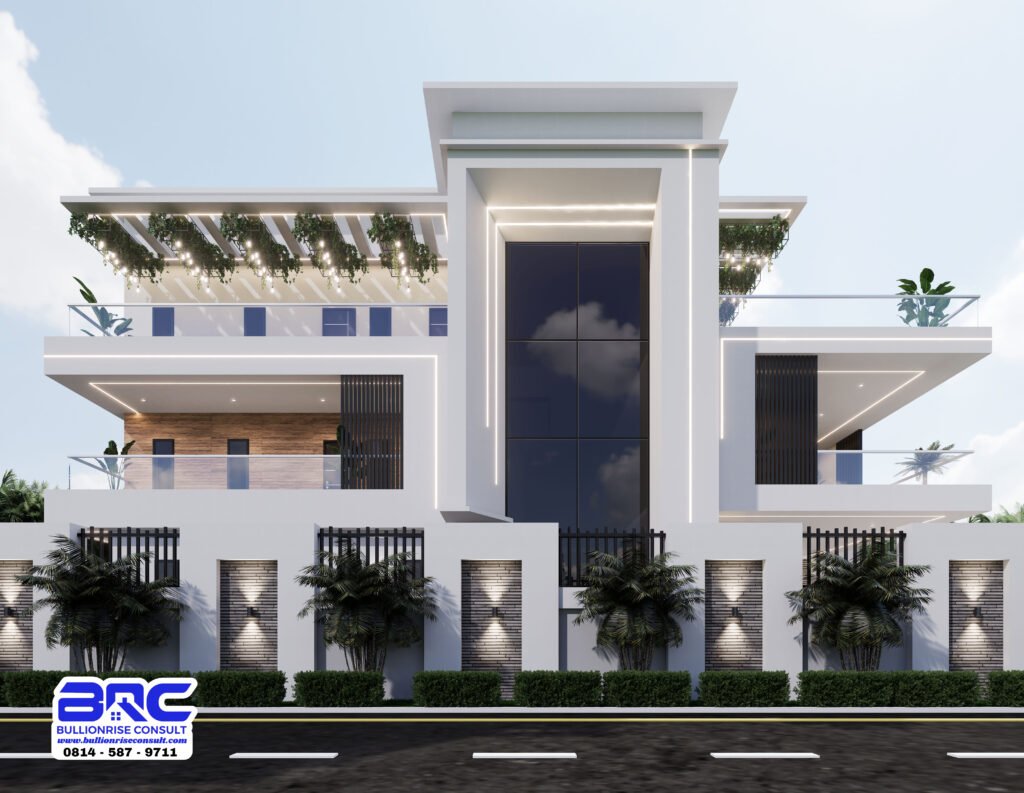
If you’ve been asking “how much will my house cost?”, the honest answer is this: it depends on your plan. Once you have the right plan, your cost stops being a mystery.
At Bullionrise Consult, we design building plans for Nigerians who want to build smart, whether that’s a simple 4-bedroom bungalow or a full family duplex. Every building plan is delivered with a free Bill of Quantity, so you don’t fall in love with a house you can’t afford to finish.
Take a few minutes to go through our building plan portfolio. Pick the layouts you like, compare sizes and styles, and see what your dream home could look like on paper before you spend a kobo on site.